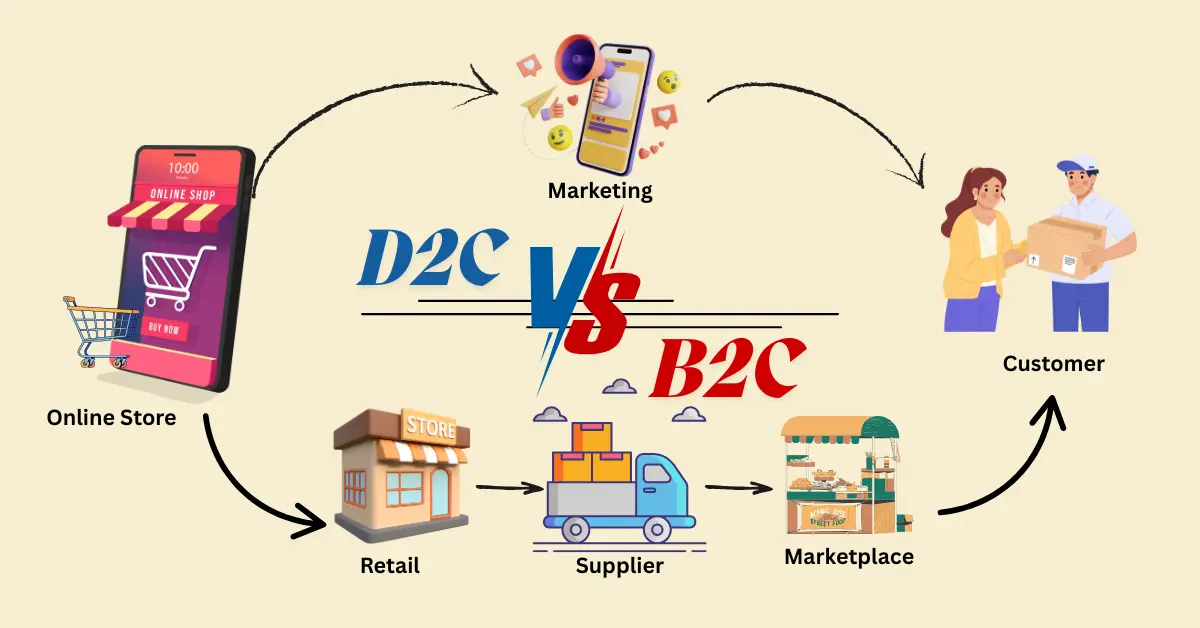
Customer behaviour is changing really quickly. Consumers used to often find big box stores and e-commerce sites like Amazon standard. The number of companies selling straight to consumers via social media and corporate websites has lately increased. Two new business models—business-to-consumer (B2C) and direct-to-consumer (D2C) are developing out of this significant change.
This blog article will outline direct-to- consumer (D2C) and business-to- consumer (B2C) marketing, highlight their differences, and assist you to choose which is best for your firm. Everyone can understand the explanations in the manner they are presented.
What is D2C?
Direct-to-Consumer, or D2C, is the practice of a business selling its goods directly to a consumer without involving any middleman or other vendor. For example, A skincare brand makes their own website and sells directly to people, that’s D2C.
How D2C Removes Middlemen:
- No need for retailers like Daraz or Amazon.
- The brand owns the full customer experience.
- It can talk directly to the customer and get feedback.
Popular D2C Brands:
- Glossier (Beauty brand selling only through its own website)
- Dollar Shave Club (Sells razors directly through subscription model)
- Casper (Sells mattresses online only)
These brands became very successful because they focused on building a strong connection with their customers and avoided extra costs from middlemen.
What is B2C?
B2C (Business-to-Consumer) is the traditional way of selling products. In this model, businesses use third-party platforms, retailers, or marketplaces to reach customers. For example, a clothing brand selling its products on Daraz or in shopping malls is using the B2C model.
B2C Model Involves:
- Using distributors, wholesalers, or resellers
- Collaborating with e-commerce companies including Amazon, Daraz, or Flipkart
- Often selling to a broader audience but with less control
B2C vs D2C: Key Differences
| Feature | B2C | D2C |
| Customer Relationship | Indirect (through retailers) | Direct (brand to customer) |
| Branding Control | Limited (depends on platform rules) | Full control over brand experience |
| Fulfillment | Handled by third-party | Brand manages its own fulfillment |
| Marketing | Platform ads or traditional ads | Influencer marketing, social media |
| Data Ownership | Shared with platform | Full ownership of customer data |
In simple words, B2C gives you reach, but D2C gives you control.
B2B vs D2C: Are They Mutually Exclusive?
Many people think a company has to be only B2B (Business to Business) or D2C. But that’s not true. A lot of companies now follow hybrid models.
Example:
- A furniture company sells in bulk to hotels (B2B), but also sells single pieces to customers on its website (D2C).
This helps them earn from both large deals and everyday customers.
D2C E-commerce & Platform Choices
When a brand wants to sell directly, it needs a strong online store. Choosing the right platform is very important.
How D2C Brands Leverage E-commerce
D2C brands use online platforms to:
- Create their own websites (using Shopify or WooCommerce)
- Run Facebook and Instagram shops
- Use WhatsApp for customer service
This way, they can talk directly to customers, take orders, and even handle returns without any middleman.

Choosing the Right D2C Ecommerce Platform
| Platform | Best For | Features |
| Shopify | Small to medium businesses | Easy setup, templates, payment integration |
| WooCommerce | Brands with WordPress sites | Flexible, open-source |
| BigCommerce | Larger brands | Scalability, multichannel selling |
When choosing, think about budget, features, and how tech-savvy your team is.
Tools D2C Brands Use:
- Email marketing tools (Mailchimp, Klaviyo)
- CRM tools (HubSpot, Zoho)
- Analytics tools (Google Analytics, Hotjar)
Role of Composable Commerce
This is a new trend. It means using different tools for different needs. For example, one tool for payments, another for product display, and another for shipping. All tools work together.
Benefits:
- Full control
- Scalability
- Easy to upgrade parts without changing the whole system
Fulfillment and Logistics in D2C
In D2C, the brand is responsible for sending the product to the customer. This can be hard, but it also allows better service.
D2C Fulfillment Challenges:
- Managing inventory
- Handling returns
- Fast shipping expectations
Best Practices:
- Use third-party logistics (3PL) partners
- Automate order tracking
- Offer multiple delivery options
Real Example (Personal Experience):
I once started a small online D2C store for handmade candles. In the beginning, I packed and shipped everything myself. It was tiring but rewarding. Later, I partnered with a courier company for faster deliveries. This improved my customer reviews and saved me time.
D2C vs B2C Marketing Strategy
| Aspect | D2C Marketing Strategy | B2C Marketing Strategy |
| Customer Data | Direct access to customer data (email, phone, behavior) | Limited data; depends on retailers or platforms like Daraz, Amazon |
| Customer Relationship | Strong, personal connection with the buyer | Indirect relationship; mostly controlled by retailers |
| Marketing Channels | Social media, email marketing, influencers, brand’s own website | TV ads, billboards, magazines, retailer-led promotions |
| Brand Control | Full control over branding, packaging, and messaging | Shared or limited branding; retailers may change product display or price |
| Customer Feedback | Instant feedback through reviews, DMs, emails, or WhatsApp | Feedback goes to the seller/platform, not always the brand |
| Ad Targeting | Highly targeted ads using first-party data (Facebook, Instagram, Google Ads) | Broader ads with mass audience targeting (radio, TV, outdoor) |
| Loyalty Programs | Easy to build loyalty through direct discounts, referrals, reward points | Hard to maintain loyalty as competition exists on retail shelves |
| Content Strategy | Storytelling, behind-the-scenes, educational content, influencer collaborations | Product-focused ads, discounts, seasonal campaigns |
| Cost of Acquisition | Can be high at the start but becomes cheaper over time with loyal customers | Usually lower per sale but depends on retailer deals or ad cost |
| Marketing Tools Used | Klaviyo (email), Meta Ads, WhatsApp Business, Shopify apps, Google Analytics | ATL (Above-the-Line) marketing tools like TV, newspaper, billboard |
| User Journey Control | Full control over the shopping journey (homepage to checkout) | Journey depends on third-party platforms or physical retail setup |
| Trust Building | Built through reviews, social proof, influencer opinions | Trust depends on the retailer’s brand or seller ratings |
Tips for D2C Marketing:
- Build an email list
- Use WhatsApp for customer support
- Collaborate with micro-influencers
- Post behind-the-scenes content
Is D2C Right for You?
Before choosing the D2C model, ask yourself:
- Can you handle logistics and shipping?
- Do you want full control over branding?
- Can you build an online community?
- Is your product easy to ship?
Pros of D2C:
- Better profit margins
- Stronger customer loyalty
- Control over pricing and discounts
Cons of D2C:
- Higher upfront setup cost
- Needs strong marketing skills
- Customer service takes time
Examples:
- Success: Nike started its own D2C website and reduced dependence on retailers.
- Failure: Some small D2C startups failed because they couldn’t manage delivery and customer care.
Conclusion
D2C and B2C are both strong business models. D2C is great if you want control, personal customer relationships, and higher profit margins. B2C works well if you want fast growth and less backend work. The choice depends on your goals, product, and team.
Start small, test the market, and grow step by step. Whether you go B2C or D2C, the most important thing is to understand your customer well.